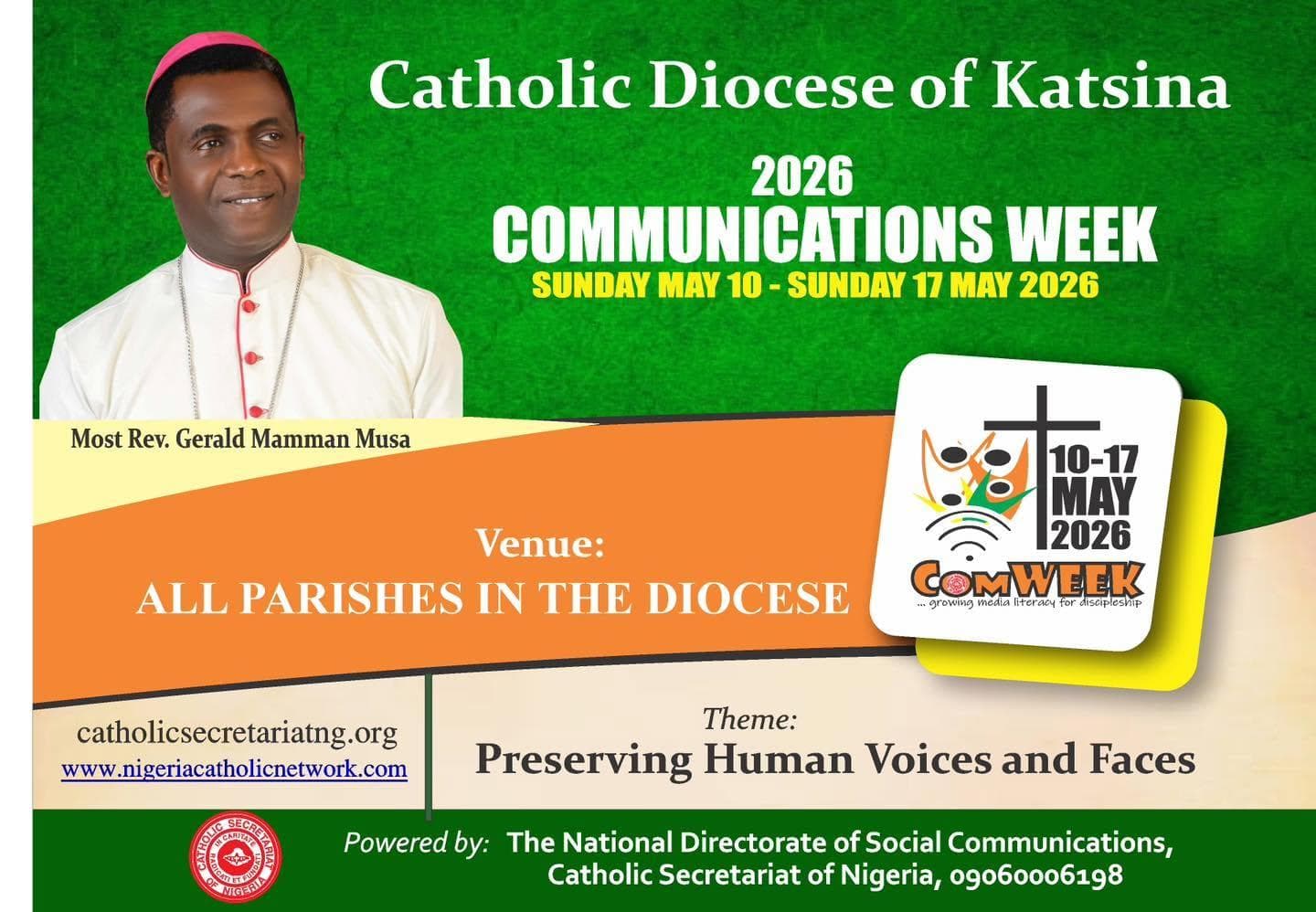
The third day of the Communications Week activities at Saint Martin’s De Porres Catholic Cathedral, Katsina, commenced with a Rosary Procession at 5:30 p.m., led by Miss Sarah Haruna of the Holy Childhood Association.
The procession was followed by the celebration of Holy Mass at 6:05 p.m., presided over by the Cathedral Administrator, Very Rev. Fr. Mathias Abbas Bakoshi.
Liturgy of the Word
The readings of the day were proclaimed by Mr. Sylvester Mkovur. The First Reading was taken from the Acts of the Apostles 16:22–34, while the Responsorial Psalm was Psalm 138, with the response: “With your right hand you save me, O Lord.”
The Gospel reading, taken from John 16:5–11, was proclaimed by Very Rev. Fr. Mathias Abbas Bakoshi.
The celebration continued with the Offertory and the Liturgy of the Eucharist, with the active participation of the faithful gathered for the celebration.
Holy Mass concluded with the final blessing at 6:30 p.m.
Communications Week Day Three
Theme: “The Fake All-Knowing Friend”
Presented by Mr. Oliver Ugwu
The major session for Day Three focused on the growing influence of Artificial Intelligence (AI) in modern communication and everyday life, under the theme “The Fake All-Knowing Friend.”
In his presentation, Mr. Oliver Ugwu observed that the world has entered a generation where technology can answer questions, write lessons and homilies, create videos, analyse information, and generate various forms of content.
He explained that this development, known as Artificial Intelligence, continues to transform the way people communicate and interact with one another.
According to him, while the Church does not remain indifferent to the rapid changes taking place in the world, she continues to educate the faithful on how to engage responsibly with emerging technologies.
However, he warned that excessive dependence on Artificial Intelligence could gradually weaken human wisdom, relationships, and even people's relationship with God.
AI Must Not Replace God and Human Wisdom
Mr. Ugwu noted that many people no longer pray or study the Word of God with the same commitment as in the past. Traditionally, children sat at the feet of their parents and elders to receive wisdom, while people sought guidance, counselling, and spiritual direction from priests and other spiritual leaders.
Today, he observed, many people increasingly turn to technology for answers and direction.
He defined Artificial Intelligence as a human-designed system capable of imitating certain human abilities, including answering questions, generating content, analysing data, translating languages, and automating tasks.
While acknowledging that AI can process information much faster than humans, he stressed that it is neither God, wisdom, conscience, nor the Holy Spirit. It cannot pray, discern right from wrong, or possess genuine human understanding.
Why AI Appears to Be an “All-Knowing Friend”
The speaker explained that Artificial Intelligence can easily be perceived as an “all-knowing friend” because:
It responds quickly.
It speaks with confidence.
It is available at all times.
Despite these qualities, he cautioned the faithful against assuming that everything produced by AI is accurate or trustworthy.
He particularly urged religious leaders not to depend solely on Artificial Intelligence when preparing sermons and homilies, noting that a machine can provide information in a convincing manner and still be wrong.
Referring to Proverbs 14:12, he reminded the faithful that Artificial Intelligence must never be allowed to replace God in their lives.
The Danger of Replacement
Mr. Ugwu identified what he described as the “danger of replacement” as one of the greatest challenges facing Christians in the age of Artificial Intelligence.
He explained that the danger lies in replacing God and genuine human relationships with technology.
He compared this growing tendency to human pride with the biblical account of the Tower of Babel, where human ambition sought to elevate itself beyond its proper limits.
Drawing inspiration from Psalm 147, he reminded the faithful that while Artificial Intelligence is built upon data and information, God remains the ultimate source of true wisdom.
He therefore encouraged Christians to begin their day with God rather than beginning their day with Artificial Intelligence.
Interactive Session Addresses Faith and Technology
The presentation was followed by an interactive question-and-answer session, during which participants raised several questions concerning the relationship between technology, faith, and Christian life.
The questions were addressed by Mr. Oliver Ugwu and the Cathedral Administrator, Very Rev. Fr. Mathias Abbas Bakoshi, who provided guidance and practical perspectives on the responsible use of technology.
One notable question focused on how Christians can maintain a healthy balance between technology and spirituality in an age where online Bibles, digital prayer resources, and other technological tools are increasingly accessible.
The responses offered clarification on how technology can serve as a useful tool without becoming a substitute for prayer, spiritual discernment, human relationships, and a personal relationship with God.
Following the interactive session, the Offertory was conducted, after which the faithful were encouraged to return the following day for another enlightening session of Communications Week.
The day's activities concluded with the closing prayer and final blessing led by the Cathedral Administrator, Very Rev. Fr. Mathias Abbas Bakoshi, at exactly 7:24 p.m.