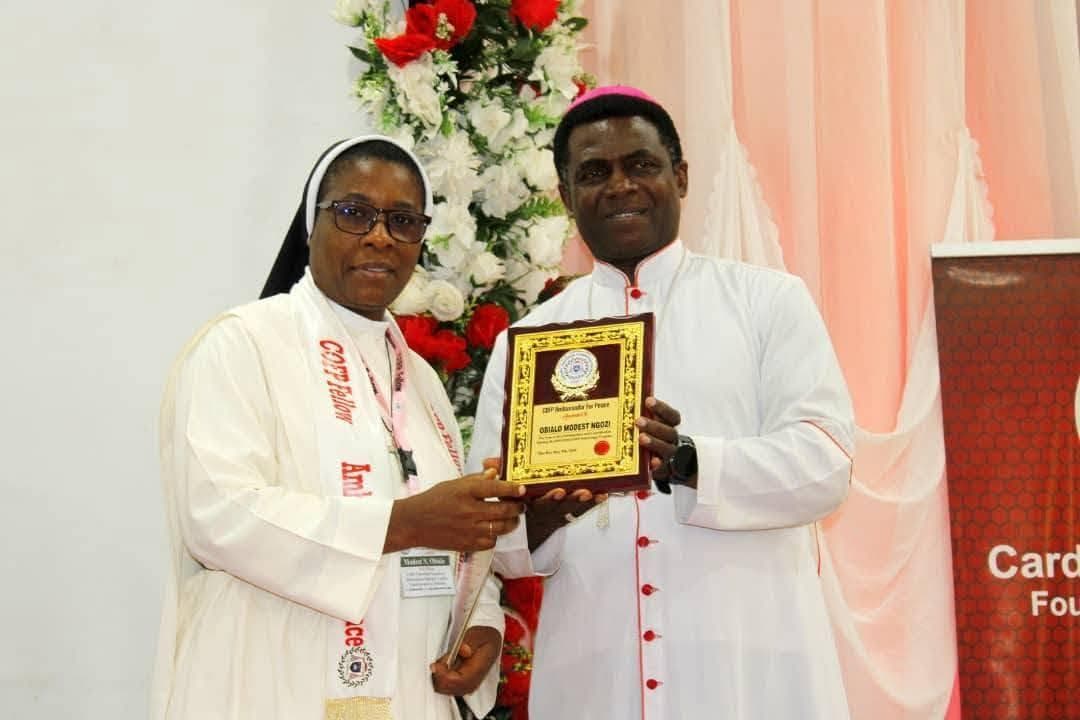
The Catholic Bishop of the Diocese of Katsina, Most Rev. Dr. Gerald Mamman Musa, has called for a more sincere, courageous, and transformative approach to interreligious dialogue in Africa, stressing that genuine engagement among people of different faiths must move beyond formal encounters to become a practical instrument for peace, justice, and human development.
Bishop Musa made the call while delivering the keynote address at the graduation and induction ceremony of the 2025/2026 fellows of the Cardinal Onaiyekan Foundation for Peace (COFP), held in Abuja on Friday, 8 May 2026.
“Every Religious Person Must Be Interreligious”
Speaking during the multi-religious gathering, Bishop Musa identified three critical principles which, he said, should guide interreligious engagement in today’s world.
First, he emphasised that authentic religious commitment should naturally lead to openness, respect, and appreciation for people of other faiths. According to the Bishop, “every religious person must be interreligious,” explaining that anyone who genuinely values his or her own religious convictions should also respect the convictions of others.
He stressed that respect for other faith traditions does not diminish one's own faith but rather demonstrates a mature understanding of religious commitment and human coexistence.
Dialogue Must Go Beyond Ceremonial Encounters
Secondly, Bishop Musa noted that interreligious dialogue must go beyond ceremonial meetings, conferences, and polite conversations.
He cautioned against superficial encounters that leave participants holding on to the same prejudices, suspicions, and misconceptions with which they entered the dialogue.
For him, genuine interreligious engagement requires sincerity, honesty, courage, and a willingness to confront difficult issues and break down barriers of mistrust, even when doing so may attract criticism or lead to isolation.
Bishop Warns Against Oversimplifying Violent Conflicts
Addressing the growing insecurity across Nigeria and other parts of Africa, Bishop Musa urged religious and community leaders to avoid hastily describing violent conflicts as purely religious in nature.
He explained that many of the crises confronting societies are considerably more complex, involving political and economic interests, as well as individuals and groups who manipulate religion for personal gain.
According to him, some actors exploit religious differences, fuel divisions, provide weapons, and take advantage of vulnerable populations to sustain violence and instability.
The Bishop therefore cautioned against reducing Nigeria’s complex security challenges to simplistic narratives such as “Christian versus Muslim” or “Fulani versus farmers,” insisting that the realities behind many of the conflicts are deeper and more complicated.
Interreligious Dialogue Must Produce Concrete Action
Bishop Musa, who has been a fellow of the Cardinal Onaiyekan Foundation for Peace since 2021, further stressed that interreligious dialogue should not be restricted to theological discussions.
Rather, he said, dialogue should inspire people of different faiths to work together on issues affecting humanity as a whole, including justice, compassion, poverty alleviation, development, peacebuilding, and human dignity.
Illustrating the need to look beyond religious labels when addressing human suffering, the Bishop narrated the story of a woman who, when asked whether she was a Muslim or a Christian, simply responded: “I am hungry.”
The story, he explained, demonstrates that human needs and suffering often transcend religious and ethnic boundaries and should become a common ground for collaborative action.
Cardinal Onaiyekan: Poverty Affects Everyone
John Cardinal Onaiyekan, founder of the Cardinal Onaiyekan Foundation for Peace, also underscored the importance of addressing the root causes of conflict and social instability.
He observed that when a nation becomes impoverished, the consequences of such poverty affect everyone, irrespective of religion or ethnicity.
His remarks reinforced the need for collective responsibility and cooperation among Nigerians and Africans of different backgrounds in confronting the social and economic conditions that often create fertile ground for conflict.
36 Fellows Graduate and Join African Peacebuilding Network
The ceremony marked the graduation of the Foundation’s eighth cohort of fellows, comprising 36 participants from Nigeria, Niger, Ghana, Somalia, and Cameroon.
The fellows successfully completed intensive training in interreligious dialogue, conflict transformation, and mediation before being formally inducted into the COFP Africa Network of Peacebuilders (CANEP).
The newly certified peace ambassadors now join a growing network of men and women committed to promoting nonviolence, reconciliation, inclusion, and peaceful coexistence across Africa.
Their mission comes at a time when many African societies continue to grapple with hate speech, social exclusion, poverty, poor governance, and other conditions that are frequently exploited to deepen divisions and sustain conflict.
Speakers Reaffirm Commitment to Peace and Inclusion
Other speakers at the ceremony included Sr. Agatha Chikeleu, Director of the Cardinal Onaiyekan Foundation for Peace; Imam Mohammad Nurayn Ashafa, Co-Director of the Interfaith Mediation Centre; Rev. Fr. Professor Hyacinth Ichoku, Vice Chancellor of Veritas University; a representative of the Vice Chancellor of Nile University; the Director of Catholic Relief Services; and representatives of the graduating fellows.
Their various presentations and messages emphasised the importance of nonviolent approaches to conflict resolution, peacebuilding, good governance, empowerment, and the need to embrace diversity as a source of strength rather than division.
A Renewed Commitment to Peace
The ceremony concluded with a renewed call for Africans of all faiths to become active agents of peace, justice, reconciliation, and human solidarity.
As communities across the continent continue to face polarisation, insecurity, poverty, and violence, the gathering underscored the importance of moving from dialogue in words to collaboration in action, building societies where religious and cultural diversity becomes a foundation for peaceful coexistence and shared human development.